Laser Treatment To Remove Stretch Marks Cost in India: What You Actually Pay
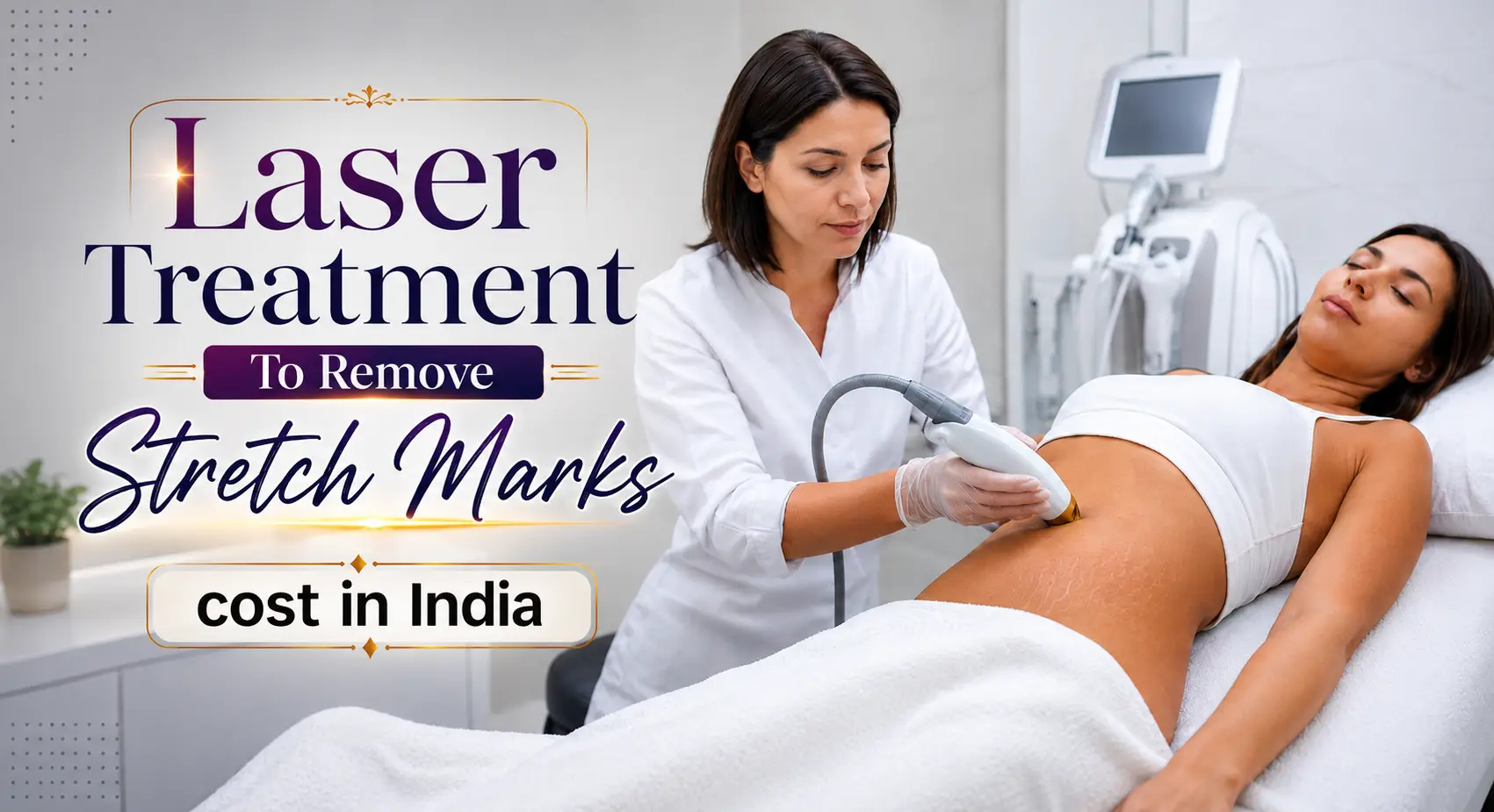
Laser Treatment To Remove Stretch Marks Cost in India: What You Actually Pay
On this page
- What one sitting costs
- What the full course costs
- Red marks or white marks
- Why two quotes differ
- Combination plans
- Area-wise pricing
- Costs outside the quote
- Insurance and RGHS
- Jaipur and tier-2 pricing
- How long it takes
- What the months feel like
- What results to expect
- Why brown skin changes the cost
- What can go wrong
- Questions to ask
- Cheaper options first
- When to treat and when to wait
- Frequently asked questions
Most people arrive at this with one question: what does laser treatment to remove stretch marks cost in India?
The awkward answer is that three clinics can quote you ₹20,000, ₹55,000 and ₹1.1 lakh for what looks from the outside like the same treatment, and all three quotes can be entirely honest. What separates them is how old your marks are, what colour they have faded to, how much skin needs covering, which device the clinic happens to own, how many sittings the doctor thinks you need, and whether a dermatologist or a technician will be holding the handpiece.
A few pink marks on the upper arms and a full abdomen of ten-year-old white marks after two pregnancies are not the same job, and no rate card printed on a banner can pretend otherwise.
What One Sitting Costs
A single sitting across India runs between ₹4,000 and ₹25,000, although most people treating a genuine area at a properly equipped clinic end up somewhere between ₹6,000 and ₹15,000 each time.
Oliva, one of the larger chains, publishes ₹3,500 to ₹5,500 per session for stretch marks, which sits at the bottom of the range because it assumes a small area. Reborn Skin & Hair in Bapu Nagar advertises CO2 laser from ₹4,000 and lists its advanced settings at ₹7,000 to ₹15,000. Delhi runs considerably higher across every device.
| Laser | Per sitting | Best suited to | Typical course |
|---|---|---|---|
| Pulsed dye | ₹5,500 to ₹15,000 | Fresh red and pink marks | 4 to 6 sittings |
| Nd:YAG | ₹6,000 to ₹18,000 | Red and purple marks | 5 to 8 sittings |
| Fractional CO2 | ₹8,000 to ₹25,000 | Deep, sunken white marks | 4 to 6 sittings |
| Fraxel | ₹10,000 to ₹30,000 | Mixed red and white marks | 3 to 5 sittings |
| Excimer | ₹7,000 to ₹20,000 | Pale marks that have lost pigment | 6 to 10 sittings |
| MNRF | Usually quoted inside a combination plan | Deep collagen loss, used alongside CO2 | Runs with the laser course |
Those are rates published by Delhi clinics. Jaipur and other tier-2 cities typically sit 30 to 40 per cent below them.
None of those per-sitting figures mean very much on their own, because one sitting will not produce a change you can actually see in a mirror.
What The Full Course Costs
Three to six sittings spaced four to six weeks apart is the usual plan, and mature white marks frequently need eight, which is why the course total rather than the sitting rate is the number worth arguing about.
Two realistic courses
Small area, tier-2 city, 4 sittings about ₹20,000
Full abdomen, metro clinic, 6 sittings ₹1.08 lakh
Published Delhi course totals span everything from ₹15,000 to well over a lakh, and neither end of that is a misprint.
For scale, the American Board of Cosmetic Surgery puts the whole treatment somewhere between $500 and $8,900, and the American Society for Aesthetic Plastic Surgery has reported averages of roughly $2,681 for an ablative treatment and $1,410 for a non-ablative one, those being per treatment rather than per course. Indian pricing sits far enough below that to explain why patients fly here to have it done.
Ask for the course price in writing before agreeing to anything, because a clinic that will only quote per sitting has effectively sold you a subscription with no stated end date. We take the same approach on our hair transplant page, on the basis that a price you have to ring up for is rarely the price you end up paying.
Red Marks Or White Marks
Colour is the single largest variable in your quote, and it happens to be the one you can check yourself in daylight before anybody examines you.
Pink, red and purple marks
Recent marks still have active blood vessels underneath, which is what gives them the angry colour and also what makes them cheaper to treat. Vascular lasers settle them in fewer sittings, three or four often being enough for a change you would notice without being told to look for it, so a moderate area tends to land somewhere between ₹20,000 and ₹50,000 in total. This stage also produces the largest proportional improvement anyone gets out of the treatment, which is worth knowing before you decide to wait and see how they settle.
Silver and white marks
Once a mark has gone pale and slightly sunken it is a mature scar, with the blood supply withdrawn, the collagen thinned and the pigment lost. Fractional CO2 and MNRF rebuild collagen from underneath, and an excimer laser is sometimes added to draw pigment back into the mark, all of which means more sittings, a longer schedule and usually two devices rather than one. A full plan on a moderate area realistically runs ₹45,000 to ₹1 lakh.
The same stretch of skin can therefore cost roughly double to treat depending on nothing but how long you left it, which is the strongest argument for going in while the marks are still red rather than waiting for them to fade.
Why Two Quotes Differ For The Same Machine
Treated surface area drives most of the gap. Lasers are billed by the skin they cover, so the doctor is not really thinking "abdomen" so much as counting passes across a measured number of square centimetres, and two women who both describe the problem as "my stomach" can be quoted 40 per cent apart when one has a narrow band under the navel and the other has marks fanning up towards her ribs.
Consumables account for more of the bill than most patients realise. An MNRF cartridge is single-use per patient and genuinely expensive, CO2 handpieces carry their own running costs, and all of that sits inside your quote whether or not anyone itemises it for you. A clinic undercutting everyone in the city on a device with costly tips is recovering that money somewhere, and it is fair enough to ask where.
Experience gets priced in as well. A dermatologist who has spent a decade learning settings on Indian skin costs more than a technician working from a preset, and on brown skin that difference functions as a safety margin rather than a luxury.
Comparing two quotes is harder than it looks, because clinics rarely measure the same thing. One writes "abdomen"; another writes "upper abdomen and flanks, approximately 400 square centimetres". The second is the one you can hold them to six months later when you are working out why you paid what you paid, so ask both of them to put the area in writing.
Combination Plans Cost More Than The Quote Suggests
Doctors treating older marks rarely rely on one device. A common protocol alternates fractional CO2 with MNRF and adds PRP or a growth factor serum immediately afterwards, while the micro-channels are still open and the serum can actually be absorbed instead of sitting on the surface doing very little. Surface texture comes from the laser and deeper collagen from the radiofrequency needles, and on stubborn white marks the stacked approach does outperform any single machine used alone.
It costs more, naturally. PRP typically adds ₹3,000 to ₹8,000 a sitting, and a stacked six-sitting course can finish 40 per cent above the single-device figure you had in your head walking in. The problem is not the protocol itself but the order in which it tends to get disclosed, so establish on the first visit whether your plan is single-device or combination and have both priced then rather than at sitting two.
Area-Wise Pricing
| Treatment area | Per sitting | Course of 4 sittings | Course of 6 sittings |
|---|---|---|---|
| Upper arms | ₹4,000 to ₹8,000 | ₹16,000 to ₹32,000 | ₹24,000 to ₹48,000 |
| Lower back | ₹8,000 to ₹14,000 | ₹32,000 to ₹56,000 | ₹48,000 to ₹84,000 |
| Thighs and hips | ₹10,000 to ₹18,000 | ₹40,000 to ₹72,000 | ₹60,000 to ₹1.08 lakh |
| Abdomen | ₹15,000 to ₹35,000 | ₹60,000 to ₹1.4 lakh | ₹90,000 to ₹2.1 lakh |
Course figures are the per-sitting rate multiplied out, so treat the upper end as a ceiling rather than a forecast. Most people land in the lower half of each band, partly because clinics discount packages by 15 to 25 per cent and partly because few patients need the maximum number of sittings.
Costs That Sit Outside The Quote
Consultation and patch test usually run ₹500 to ₹1,500, sometimes waived and sometimes adjusted against your first sitting. The patch test is the one worth insisting on with brown skin, whatever a clinic tells you about saving a week.
Numbing cream may be included or billed separately, and it matters more than it sounds, since fractional CO2 across a large area without topical anaesthetic makes for a very long hour.
Aftercare runs for the entire three to six months you are in treatment, meaning medical sunscreen, a barrier moisturiser and occasionally a silicone gel. Sunscreen is the non-negotiable item, because treated skin that catches Jaipur sun will pigment and you will then be paying to correct that rather than paying for progress. Our basic skin care list covers the rest of it.
Ask whether GST sits inside the quoted figure, allow for two or three days of redness after each CO2 sitting, and avoid booking one in the week of a wedding. Budget loosely for a maintenance sitting somewhere around the one-year mark as well, since treated marks stay treated but skin carries on ageing and fresh marks arrive with weight change.
Insurance, RGHS And Chiranjeevi Yojana
Stretch mark laser is classified as cosmetic, so no Indian health insurance policy pays for it, and neither RGHS nor Chiranjeevi Yojana will cover it either, even at a hospital like ours that runs both schemes for surgical and medical work. The whole cost is out of pocket and it is better to plan for that from the start than to discover it at the billing counter.
Jaipur And Tier-2 City Pricing
A course in Jaipur, Lucknow or Indore usually lands 30 to 40 per cent under the same course in South Delhi or Bandra, which reflects rent, salaries and what the local market will bear rather than any difference in what you receive.
The same economics work against you at the bottom of the market. Lower price points squeeze equipment budgets, so smaller cities carry proportionally more clinics running older machines under a technician-led model, and the cheapest quote in your city is generally cheap because of the machine or the person operating it.
We ended up structuring stretch mark work at CBLM Holy Family Hospital around a dermatologist consult before anybody books a sitting, which was less a matter of principle than of what kept happening at the front desk. People would arrive braced for a lakh, get examined properly, and turn out to have red marks needing four sittings instead of eight. A few are told lasers are the wrong tool for what they have, which is a poor sales conversation and a sound medical one, and rather easier to have in a hospital where no single treatment line carries a monthly target. The work sits alongside our cosmetic surgery unit, and the hospital's wider laser surgery work covers a very different set of conditions.
How Long The Whole Thing Takes
Sittings are set four to six weeks apart because collagen needs that long to remodel, so a four to six sitting plan occupies four to eight months and the money leaves your account in instalments rather than in one go. Most clinics discount a package of four to six sittings by 15 to 25 per cent against the individual rate and will put it on EMI, which is worth taking only once the doctor has committed to a count. Buying six when three would have done is a common and entirely avoidable way to overspend.
What The Four Months Actually Feel Like
The first sitting feels like heat and pinpricks through the numbing cream, and you go home red and warm in the manner of bad sunburn, with two or three days of rough texture to follow and, with CO2, a scatter of tiny dark specks on the surface that flake away on their own if you leave them alone.
Then comes the stretch nobody warns you about, where for the next fortnight or so very little appears to be happening at all. Collagen remodelling is slow and it goes on underneath, out of sight, and that rather than scheduling convenience is the reason for the long gap between appointments. A fair number of people conclude around this point that they have wasted their money.
Texture usually starts shifting by the third sitting and you tend to feel it under your hand before you can see it in a mirror. Visible colour change arrives later, generally around the fourth or fifth, and the result carries on improving for three to six months after the final appointment, which means anybody assessing their outcome a fortnight after the last sitting is assessing it far too early.
What Results Can You Actually Expect
What a good course buys is a partial improvement rather than removal. Texture softens, the marks narrow, and the colour moves closer to the skin around them, which photographs well and can look dramatic in a before and after. Under a tube light in a changing room you will still know exactly where your marks are.
Anyone promising complete removal is either being careless with language or selling you something, because these are scars sitting in the dermis and lasers remodel scar tissue rather than deleting it. The patients who finish satisfied are generally those who paid for something like a 60 per cent improvement and received it, while the ones who feel cheated had been sold a disappearance.
Why Brown Skin Changes The Cost
Most Indian patients fall at Fitzpatrick type IV or V, where higher melanin content raises the risk of post-inflammatory hyperpigmentation, meaning the treated skin darkens after a sitting instead of evening out. The standard way of managing that is to drop the energy settings and add sittings, which is safer and costs more in total than one aggressive high-energy run would have.
That inverts the instinct most people bring to a reception desk. A clinic offering to finish your abdomen in two powerful sittings is offering a quick route to a pigmentation problem that then needs its own course of treatment to correct, and paying twice for the same stretch of skin is not a rare outcome. Ask which device they intend to use on your skin type and whether they have treated type V with it, because the answer takes ten seconds and its precision or vagueness tells you most of what you need to know.
What Can Go Wrong
Redness, swelling and a sunburnt feeling for a few days is the expected response rather than a complication. Pigmentation is the common problem on Indian skin and is usually temporary, though correcting it takes months and its own run of appointments. Blistering, infection and scarring are rare, and they almost always trace back either to settings that were too aggressive or to aftercare that was skipped.
Nobody should be treating you during an active skin infection, on freshly tanned skin, or while you are taking isotretinoin, so a clinic that books you in without asking about any of that has already told you something useful about its standards.
Questions To Ask Before You Pay
Worth having these written down before the consultation rather than trying to remember them across the desk.
- What is the total course price in writing, GST included, and how many sittings is that based on?
- Which device will you use, and why that one for my marks?
- Are my marks red or white, and what does that do to the session count?
- Will a dermatologist or a technician perform it?
- Will you do a patch test, and when?
- What happens if I pigment after sitting two, and who pays to correct it?
- What is included in aftercare, and what am I buying separately?
- If I need fewer sittings than the package, do I get the balance back?
The last of those separates clinics quickly, because one that is confident in its own assessment answers yes without needing to think about it.
Cheaper Things Worth Trying First
Marks that appeared within the last few months and are still pink are worth showing to a dermatologist for a prescription retinoid or a properly formulated topical before you commit to anything expensive. A few hundred rupees a month and six weeks of patience is a reasonable thing to spend before ₹50,000.
Microneedling on its own, chemical peels and plain radiofrequency occupy the middle bracket at roughly ₹2,000 to ₹6,000 a sitting and produce modest results on shallow marks. On deep, old, white marks they generally underdeliver, and you tend to arrive at the laser eventually having already spent the money once.
Creams sold with before and after photographs on the box do very little for mature marks. Cocoa butter is pleasant on skin and is not remodelling dermal collagen.
Set against each other, the options separate fairly clearly on what they can and cannot reach.
| Option | Cost | Worth it for | What it will not do |
|---|---|---|---|
| Fractional CO2 or MNRF | ₹6,000 to ₹15,000 a sitting | Deep white marks and lost texture | Erase the mark completely |
| Vascular laser | ₹5,500 to ₹18,000 a sitting | Recent red and purple marks | Help much once marks turn white |
| Microneedling alone | ₹2,000 to ₹6,000 a sitting | Shallow, recent marks | Reach deep dermal scarring |
| Chemical peel | ₹2,000 to ₹6,000 a sitting | Surface tone and very mild marks | Rebuild collagen that has already thinned |
| Prescription retinoid | A few hundred rupees a month | Marks only a few months old and still pink | Do much for mature white marks |
| Over-the-counter creams | Varies | Keeping skin comfortable and moisturised | Change the mark itself |
Nothing in the lower half of that table is a substitute for the upper half on old marks. It is a question of matching the tool to what your skin has actually lost.
When To Treat And When To Wait
Do not start while pregnant or breastfeeding, and wait until your weight has held steady for a few months afterwards, because marks forming mid-course means paying to chase a moving target. Anyone partway through serious weight loss should finish that first and book after.
The best moment to spend, if you have the choice, is while the marks are still red and your weight is stable, since that combination produces the most improvement for the least money and it does not come round again. Marks that have been white for a decade are still worth treating if the texture bothers you and you have budgeted honestly for five or six sittings, which is a rather different decision from being tempted in by a banner advertising ₹4,000.
Frequently Asked Questions -
How much does laser treatment for stretch marks cost in India?
Between ₹4,000 and ₹25,000 a sitting, and ₹20,000 to over ₹1 lakh for a full course. Where you land inside that range depends mostly on the size of the area being treated and on whether your marks are still red or have already turned white.
Can laser remove stretch marks permanently?
It permanently reduces how visible they are without erasing the scar itself. The improvement you gain does not fade back, but the marks remain findable if you go looking for them, and new ones can still form later if your weight changes significantly.
How many sittings will I need?
Three to six for most people, spaced four to six weeks apart. Red marks often settle within three or four, whereas old white marks can take eight. Any clinic quoting you a number before examining your skin is guessing at it.
Is laser stretch mark removal painful?
With numbing cream most people describe heat and pinpricks rather than pain, and fractional CO2 across a large area is the least comfortable version of it. The soreness afterwards feels like sunburn and settles within two or three days.
Is laser stretch mark removal safe on Indian skin?
Yes, provided the settings are matched to your skin type and a patch test is carried out first. The genuine risk on Fitzpatrick IV and V skin is pigmentation rather than burns, and it is managed by using lower energy across a greater number of sittings.
Which laser is best for stretch marks?
There is no single best one. Pulsed dye and Nd:YAG suit red marks, fractional CO2 and MNRF suit white ones, and excimer is used to draw pigment back into pale marks. What is right for you depends on what your marks look like today rather than on which machine a clinic happens to own.
Is laser or microneedling better value for stretch marks?
Microneedling runs ₹2,000 to ₹6,000 a sitting against ₹6,000 to ₹15,000 for laser, so it looks cheaper on paper. On shallow recent marks it can be enough, but on deep white marks it usually is not, and paying for both courses ends up costing more than starting with the right one.
Can I get laser stretch mark removal while pregnant or breastfeeding?
No. Wait until you have finished breastfeeding and your weight has held steady for a few months, because treating skin that is still changing means paying twice for the same area.
Does laser work on old white stretch marks?
Yes, though more slowly and at greater cost. Improvement on marks older than five years is real but partial, and it usually needs fractional CO2 and MNRF working together rather than a single device.
How long is the downtime after each sitting?
Two to three days of redness and rough texture with fractional CO2, and less than that with non-ablative lasers. You can work through it. Sun exposure is the thing to avoid, not activity.
Latest Blogs







Top 10 Helpful Tips To Treat Piles
17 February
What is Dengue? Symptoms, Causes and Treatment.
17 February
Top 10 Ways To Cleanse Your Body Thoroughly
17 February
Top 10 Ways To Keep Your Kidney Healthy
17 February


Gain complete insight of Piles and Its Cure
17 February
Stress, A Silent Initiator Of Piles Problems!
17 February




How to Find the Best Gynaecologist in Jaipur
17 February