Piles are graded 1 to 4 on one thing only: how far the swelling comes out of the anal canal, and whether it goes back in.
Grade 1 stays inside. Grade 2 comes out when you strain and slides back on its own. Grade 3 comes out and has to be pushed back by hand. Grade 4 stays out permanently.
The grade decides the treatment, not the pain. Grades 1 and 2 usually settle with diet, medication or a short OPD procedure. Grades 3 and 4 usually need surgery.
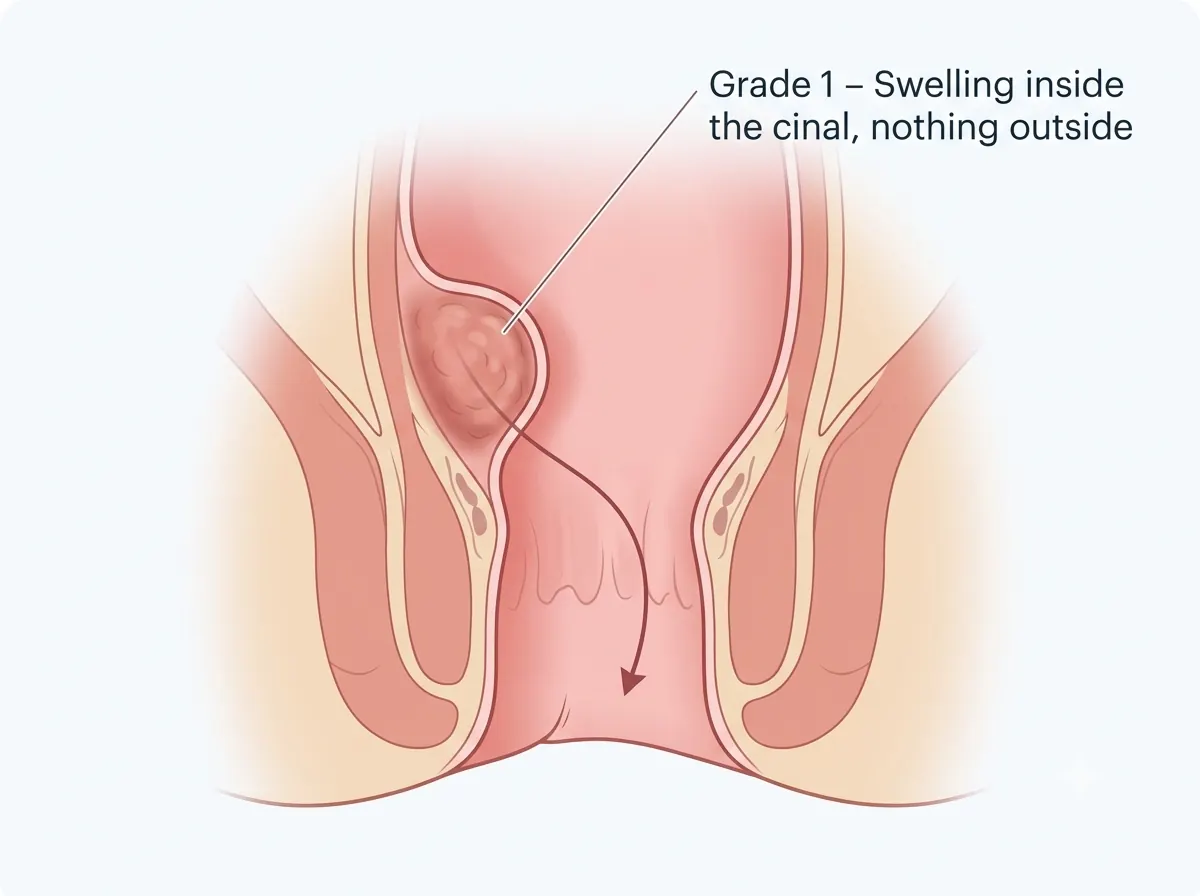
Swelling sits inside. Nothing comes out.
Bright red blood, no lump, no pain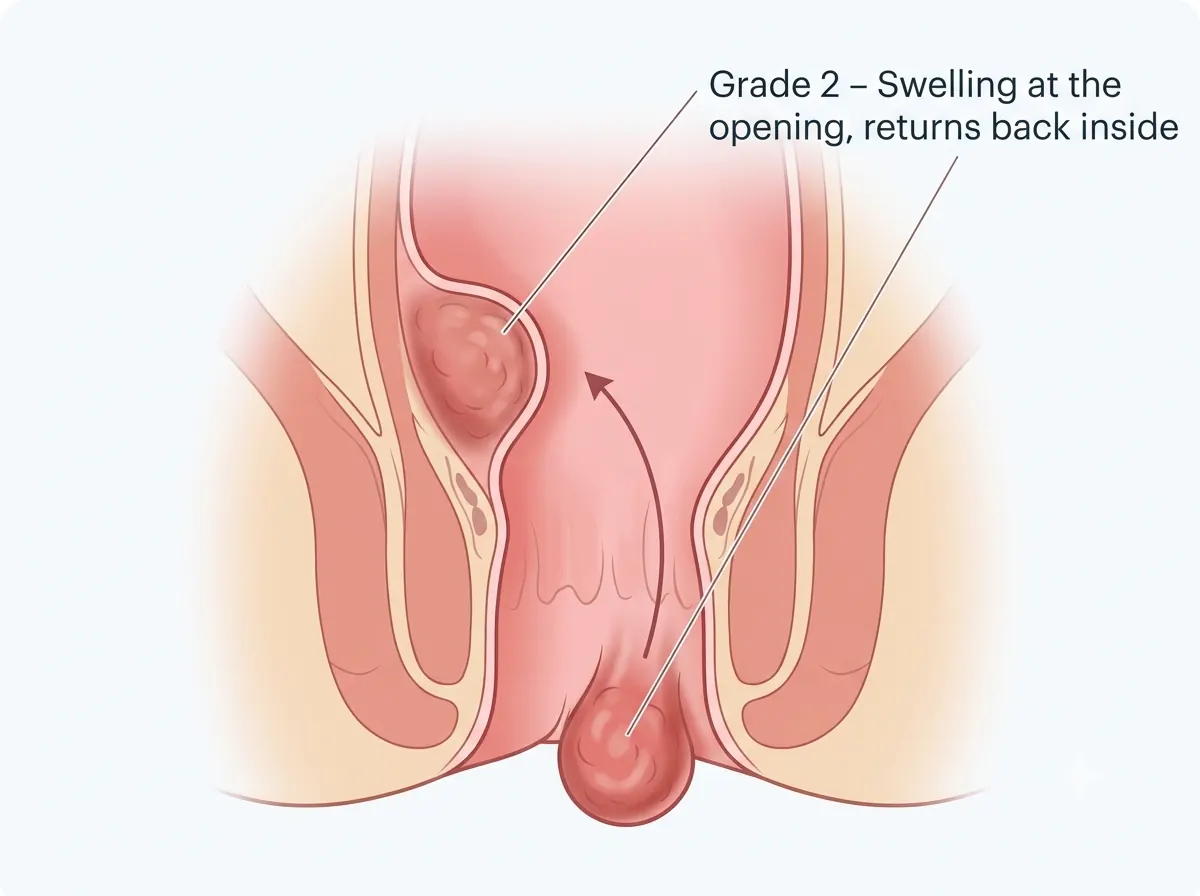
Comes out on straining, returns by itself.
A lump while passing stool that disappears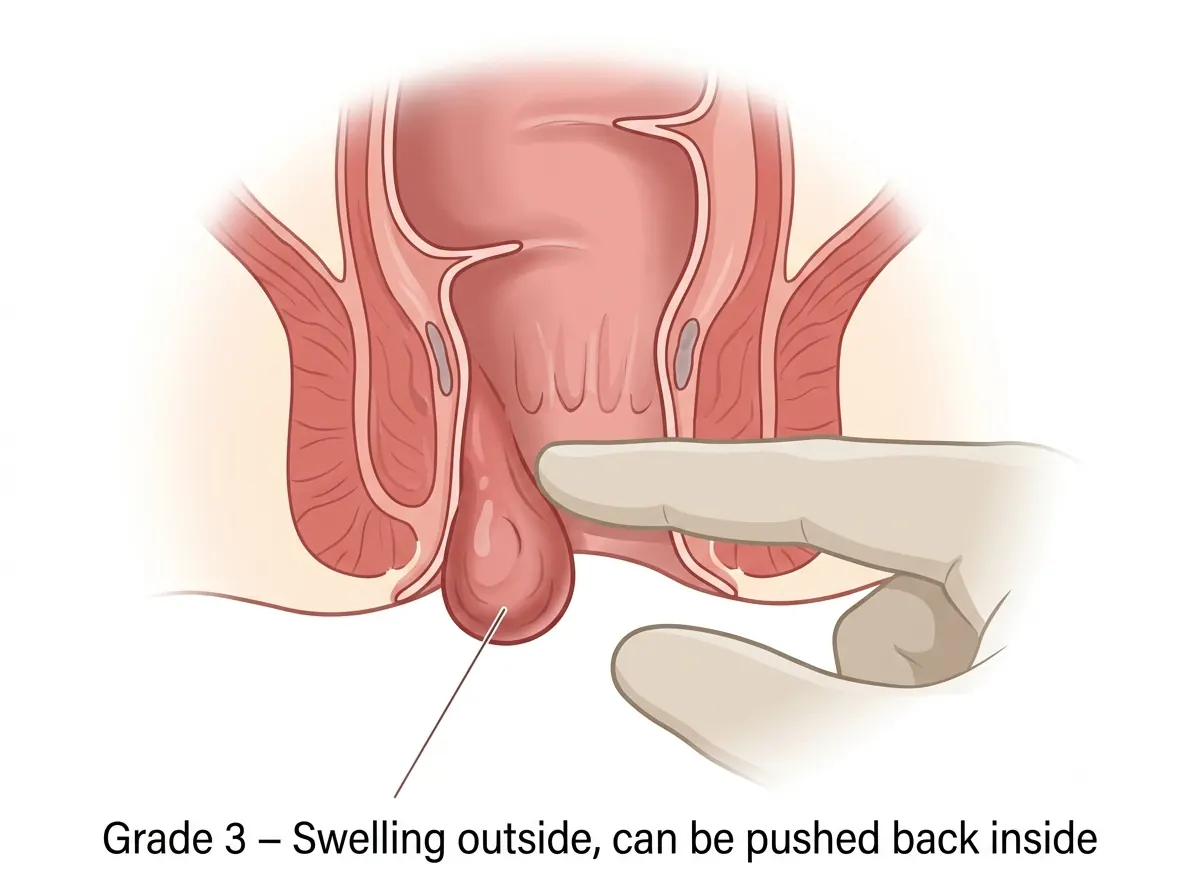
Comes out and stays out until you push it in.
Lump you reduce with a finger, mucus, itching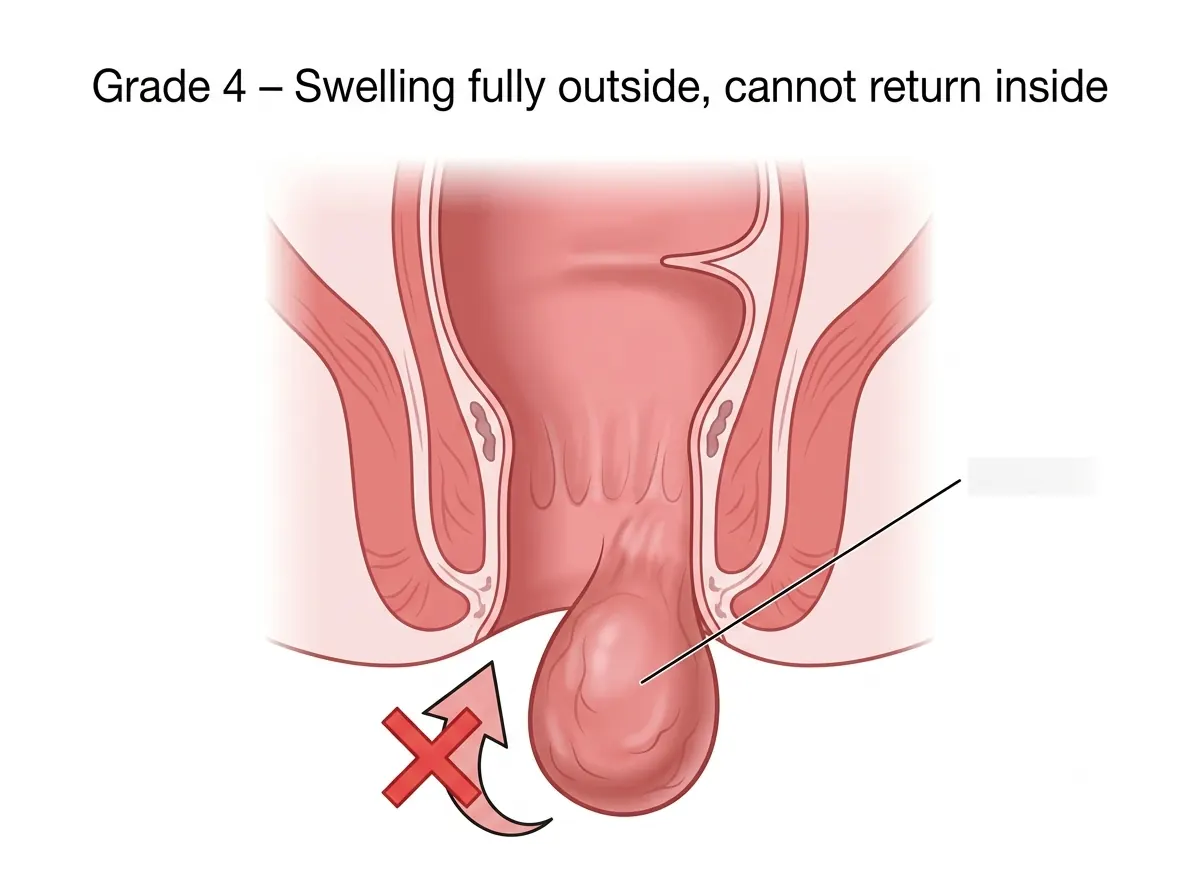
Permanently outside. Cannot be pushed back.
Constant lump, soiling, pain if it gets trappedSomebody mentions the word piles and the first thing most people do is search for pictures. Then they find a page with four photographs that all look much the same, a paragraph of medical vocabulary, and no clear answer to the only question they actually had, which is how bad is mine.
The answer is simpler than the internet makes it look. There is one test, it takes a second, and you can do most of it yourself before you ever see a doctor.
What does "grade" actually mean in piles?
The grade is not about how much it hurts, how much you bleed, or how big the swelling feels. It is about prolapse, which is the medical word for tissue coming down and out through the anal opening.
That distinction matters, because pain is a terrible guide. Grade 1 piles can bleed heavily every single day and never hurt at all. Grade 4 piles can be almost painless right up until the moment they get squeezed. Judge by symptoms alone and you will usually guess the grade wrong, normally guessing too low.
One more thing before you read further. Grading applies to internal piles only. External piles, the ones you can feel as a lump right at the opening, sit outside this scale completely.
The four grades of piles compared
| Grade | Does it come out? | Does it go back? | Usual first treatment |
|---|---|---|---|
| Grade 1 | No, stays inside | Not applicable | Fibre, water, medication |
| Grade 2 | On straining only | By itself | Banding or an OPD procedure |
| Grade 3 | Yes | Only when pushed | Laser or surgery |
| Grade 4 | Always out | No | Surgery |
Grade 1 piles
The swollen veins sit inside the anal canal and never appear outside it. Most people at this stage have no idea they have piles at all until they look down and see blood.
That bleeding is typically bright red, sits on the surface of the stool or drips into the pan afterwards, and is not mixed through. It is painless, which is precisely why people leave it for months and sometimes years.
Grade 1 is the cheapest and easiest stage to deal with. Fix the constipation, stop straining, and a lot of people never progress beyond it. Our guide to treating piles day to day covers most of what works at this stage.
Painless rectal bleeding is also the first sign of several conditions that are considerably more serious, including bowel cancer. Nobody can tell the difference by description alone, not over the phone and not from a photograph.
Get it examined once, properly, and then you can stop worrying about it. That is a ten minute appointment, and it is the single most useful thing on this page.
Grade 2 piles
Now the swelling comes down through the opening when you strain, and travels back up on its own when you stop. You may feel a soft lump for a minute or two and then it is gone again.
Bleeding usually continues. Some people also notice a little mucus, or a nagging feeling that the bowel has not emptied properly even when it has. That feeling is the pile itself, not leftover stool.
Grade 2 is where an outpatient procedure such as rubber band ligation genuinely works, and it is the last comfortable off-ramp before surgery becomes the realistic option. People who act at grade 2 tend to be glad they did.
Grade 3 piles
The swelling comes out and stays out until you physically push it back with a finger. Doctors call that manual reduction, and it is the single dividing line that changes the whole treatment plan.
By this stage most people also have mucus discharge, itching around the opening, and skin irritation from the constant dampness. Bleeding sometimes reduces, which people understandably read as improvement. It is not.
Grade 3 is the most searched of the four grades, and it is usually the point at which people finally book an appointment. Creams and tablets will not reverse it, because the damage is structural rather than inflammatory. What they can do is settle the symptoms while you decide what to do.
Grade 4 piles
The swelling is permanently outside and cannot be pushed back in, or it comes straight back out the moment you let go. It is often visible, uncomfortable to sit on for any length of time, and can leak mucus or stain underwear.
The real risk at grade 4 is strangulation. If the blood supply to the trapped tissue gets cut off, the pain arrives suddenly and severely, and that is an emergency rather than something to manage at home over a weekend.
If the lump becomes severely painful and hard, turns dark or blue-purple, you cannot pass stool or urine, or you are bleeding heavily enough to feel faint or dizzy, that is a surgical emergency.
Go to a hospital with an emergency department the same hour. Do not wait for an OPD slot and do not wait to compare prices.
Types of piles, and how they differ from grades
People mix these two up constantly, and the confusion causes real problems, because someone with external piles will read the grading scale and conclude they have grade 4 when they do not have a grade at all.
The type tells you where the pile is. The grade tells you how far an internal one has come down. You can have more than one type at the same time, and most people with long-standing piles do.
If the lump sits right at the opening, is tender to touch, and has been there since the day it appeared, you are almost certainly dealing with an external pile rather than a grade 4. The treatment is different, and usually simpler.
Are piles grades different in women and men?
The grading system is identical. What differs is how people arrive at each grade, and how quickly.
In women
Pregnancy and childbirth are the most common triggers by a wide margin. The weight of the growing uterus raises pressure in the pelvic veins for months, and then the straining of labour can push piles out by several grades in a single day.
The good news is that many pregnancy-related piles settle considerably in the weeks after delivery, which is exactly why surgeons normally wait rather than operating during pregnancy. If yours appeared during a pregnancy, give it time before assuming you need surgery.
In men
The usual drivers are long unbroken hours sitting, heavy lifting at work or in the gym, and chronic constipation from a low-fibre diet. Men also tend to present later, so a higher proportion arrive at the clinic already at grade 3 or 4.
One warning that applies to everybody. Piles are extremely common, but they are not the only cause of bleeding or a lump. Age over 40, a change in bowel habit lasting more than a few weeks, unexplained weight loss or a family history of bowel cancer all mean the examination needs to go further than a quick look.
How a doctor decides your grade
You cannot grade piles from a photograph or a symptom checklist, and no honest clinic will grade you over the phone. It takes a short examination, and the whole thing is over in a few minutes.
If anything does not fit a straightforward diagnosis of piles, expect to be sent for a colonoscopy. That is not the doctor being alarmist or padding the bill. It is the correct response to bleeding that has not been fully explained, and it is how the serious things get caught early.
Treatment for each grade
Treatment follows the grade rather than the symptoms. This is the entire reason the grading system exists.
| Grade | What normally works | What will not fix it |
|---|---|---|
| Grade 1 | Fibre, water, not straining, a short course of medication | Nothing more is usually needed |
| Grade 2 | The above, plus rubber band ligation or sclerotherapy in OPD | Creams alone, long term |
| Grade 3 | Laser treatment, stapled surgery, or conventional haemorrhoidectomy | Creams, tablets and home remedies as a cure |
| Grade 4 | Surgery, usually haemorrhoidectomy | Any non-surgical option as a permanent fix |
Laser treatment is the option most people ask about for grade 3, and for good reason. It generally means less post-operative pain and a faster return to work than conventional surgery. It is not right for every case though, and a surgeon who recommends conventional surgery for a large grade 4 is giving you correct advice rather than outdated advice.
Piles also keep company with two related conditions. If passing stool causes a sharp tearing pain rather than a dull ache, you may be dealing with a fissure as well. If there is recurring discharge or a small opening near the anus, that points towards a fistula. Both are treated differently from piles, and both are commonly mistaken for them.
Can piles go back down a grade?
Partly, and it depends entirely on where you are starting from.
Grade 1 and grade 2 piles genuinely can settle. Fix the constipation, stop straining, stop sitting on the toilet scrolling your phone, and the swelling can reduce enough that symptoms disappear for years at a stretch. Our page on managing piles at home is aimed squarely at this group.
Grade 3 and grade 4 do not reverse. The supporting tissue that held the pile in place has already stretched and torn, and no diet repairs torn tissue. Good habits will reduce your symptoms and stop things deteriorating further. They will not put the structure back.
That is not a reason to give up on the habits. It is a reason to stop waiting for them to work as a cure.
How to stop piles reaching the next grade
Ask yourself this: does anything come out, and if it does, does it go back by itself, only when pushed, or not at all?
Nothing comes out is grade 1. Goes back by itself is grade 2. Only when pushed is grade 3. Will not go back is grade 4. That single answer places you on the scale more accurately than any photograph on the internet.
We wrote this page at CBLM Holy Family Hospital because of how many people arrive at the OPD having already decided their grade from a Google image search, and having got it wrong in both directions. Some have spent a year on creams for a grade 3. Others have convinced themselves they need surgery for a grade 1 that would settle with fibre.
A proctoscopy takes a few minutes and settles the question properly. Our piles treatment team in Jaipur will tell you your actual grade and what it does and does not require, including when the honest answer is that you need no procedure at all. We accept RGHS and Chiranjeevi Yojana. If you want that checked, book a consultation.
Piles Grades: Common Questions
What are the four grades of piles?
Grade 1 stays inside the anal canal and never comes out. Grade 2 comes out when you strain and returns on its own. Grade 3 comes out and must be pushed back by hand. Grade 4 stays outside permanently and cannot be pushed back at all.
Which grade of piles needs surgery?
Usually grade 3 and grade 4. Grade 1 and grade 2 normally respond to diet changes, medication, or an outpatient procedure such as rubber band ligation. Surgery at grade 1 or 2 is rarely necessary.
Is grade 3 piles serious?
It is not dangerous in itself, but it will not reverse on its own and it tends to progress. The realistic choice at grade 3 is between treating it now or treating a grade 4 later, which is a bigger operation with a longer recovery.
Can grade 3 piles be cured without surgery?
The symptoms can be controlled without surgery. The prolapse itself will not go away, because the supporting tissue has already stretched and torn. Anyone promising a permanent cure for grade 3 with tablets, creams or oils is overselling.
How do I know which grade of piles I have?
Ask one question: does anything come out, and if so, does it go back by itself, only when pushed, or not at all. That answer separates all four grades. A proctoscopy in OPD confirms it in a few minutes.
Do grade 1 piles always become grade 4?
No. Many people stay at grade 1 or grade 2 for life, particularly once constipation and straining are under control. Progression is common but it is not inevitable, and the earlier you act the less likely it becomes.
Are piles grades the same as types of piles?
No. Type means where the pile is, internal or external. Grade means how far an internal pile has prolapsed. External piles are not graded on the 1 to 4 scale at all, which is a common source of confusion.
Can piles be graded during pregnancy?
Yes, and the same 1 to 4 scale applies. Surgeons normally avoid operating during pregnancy unless there is a complication, because a large proportion of pregnancy-related piles improve considerably in the weeks after delivery.
Does the grade of piles affect the cost of treatment?
Significantly. Grade 1 and 2 are usually managed in OPD at minimal cost. Grade 3 and 4 need a procedure or surgery, which involves theatre time, anaesthesia and a hospital stay. Both RGHS and Chiranjeevi Yojana cover piles surgery at empanelled hospitals.